
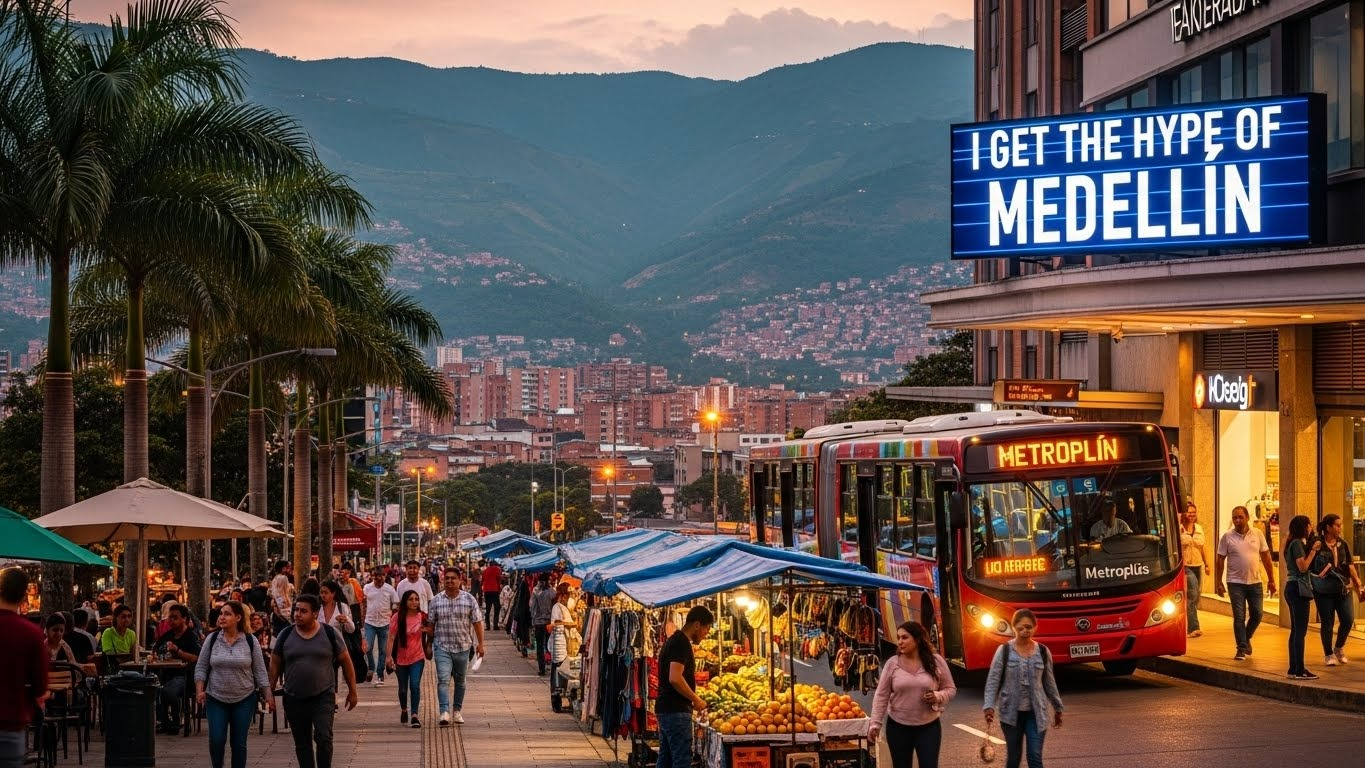
Before I ever set foot in Colombia, I had already heard Medellín’s name many times. More than Bogotá. More than Cali. Even more than Cartagena. It was always Medellín that people talked about. Travelers praised it. Digital nomads loved it. Bloggers wrote poetic posts about it. Friends described it with glowing eyes.
Medellín seemed to carry a quiet promise—a city that surprises you, a place that feels alive yet calm, modern yet deeply rooted in its past. People said it was beautiful. They said it was innovative. They said it had transformed itself.
Naturally, I was curious.
Still, no amount of reading, scrolling, or watching videos truly prepares you for the feeling of arriving in Medellín for the first time.
After days spent in the sticky heat and heavy humidity of Cartagena, Medellín felt like a gentle sigh of relief. As our taxi drove out of the long tunnel that leads into the valley, the city slowly revealed itself. Mountains rose on every side, wrapping the city like protective arms. Buildings filled the valley floor, glowing softly under a pale sky.
I remember smiling without realizing it.
That was the moment I understood the hype.
First Impressions: A City Cradled by Mountains
Medellín does not overwhelm you all at once. It unfolds slowly.
The city sits in the Aburrá Valley, surrounded by lush green mountains that change color with the light. In the morning, they feel calm and misty. In the afternoon, they glow deep green. By evening, they turn dark and mysterious.
From almost anywhere in the city, you can see these mountains. They are always there, reminding you that nature is never far away.
The weather was another pleasant surprise. Medellín is known as La Ciudad de la Eterna Primavera — the City of Eternal Spring. And it earns that name honestly. The air felt cool but not cold. Warm but never suffocating. Even when it rained, the rain felt refreshing rather than annoying.
After Cartagena’s relentless heat, this balance felt like a gift.

The Scenery: Beauty at Every Level
One thing Medellín does exceptionally well is scenery. It doesn’t matter where you are—a rooftop, a street corner, a café, or a hillside neighborhood—there is always something beautiful to look at.
We stayed at Los Patios Hostel, and from the moment we arrived, the views took my breath away. From the rooftop, the city stretched endlessly below us, framed by rolling mountains in every direction. During the day, clouds drifted lazily across the sky. At night, thousands of city lights flickered like stars fallen to earth.
One afternoon, we attended a “Sunday Funday” event at the hostel’s second building just around the corner. There was a warm pool with glass walls that didn’t interrupt the view. Sitting in that pool, surrounded by steam, rain tapping gently against the glass, and mountains fading into mist — it felt almost unreal.
Even the rain in Medellín has its own kind of beauty. When it rains, the city slows down. Colors deepen. The air becomes cleaner. Everything feels softer.
Medellín invites you to pause and look around.
A City That Lives and Breathes Street Art
If you know me at all, you know I have a deep love for street art. Murals tell stories. They give cities their voice. And Medellín has a powerful voice.
Street art here is not decoration. It is memory. It is a protest. It is healing.
Walking through different neighborhoods, you’ll find walls bursting with color. Faces of women, children, activists, and musicians. Scenes of pain, resilience, hope, and pride. Each mural feels intentional. Each one has something to say.
Downtown Medellín offers plenty of street art, but the heart of it lives in Comuna 13.
Comuna 13 was once known as one of the most dangerous neighborhoods in the world. Today, it stands as a symbol of transformation. Art played a huge role in that change. Murals line the streets, telling stories of loss, violence, resistance, and rebirth.
Artists here paint not to forget, but to remember honestly.
Walking through these streets is emotional. It reminds you that Medellín’s beauty is not just visual — it is deeply human.

Food and Drink: A City That Knows How to Eat Well
Before arriving, I had heard good things about Medellín’s food scene. But I didn’t realize just how good it really was.
Our introduction to Medellín’s culinary world began at Alambique, and it could not have been better. The restaurant has stylish décor, a warm atmosphere, and cocktails that feel like artwork. We ordered several small plates to share, and each one was thoughtfully prepared and full of flavor.
It was a Sunday afternoon, and the place was alive with conversation and laughter. Locals and travelers sat side by side, enjoying long lunches and slow moments.
The next day, we had lunch at Lorenzza Pizzeria, an authentic Italian spot that could easily compete with restaurants in Europe. Simple ingredients. Perfect balance. Food that feels comforting and special at the same time.
Medellín is filled with places like this.
So many restaurants came highly recommended that we couldn’t possibly visit them all. Places like Herbario Restaurante, OCI.mde, Mondongo’s El Poblado, Carmen, 37 Park Medellín, and the Mercado del Río food hall were all on our list.
Each one promised something different—traditional flavors, modern twists, or international influences. Medellín’s food scene is global, creative, and surprisingly affordable.
Craft Beer and Nighttime Energy
Medellín also knows how to enjoy its evenings.
We had planned to visit Bipolar Brewing and 20 Mission Cerveza, but both happened to be closed when we tried. Instead, we stumbled into Foxey Pub, and honestly, it turned out to be a great alternative.
Foxey Pub is like a beer lover’s playground. Seven different breweries under one roof. Plenty of space. Big screens showing soccer matches. A lively but relaxed atmosphere.
It felt like a place where locals actually hang out — not just tourists.
We also wanted to visit Medellín Beer Factory and 3 Cordilleras, both known for excellent craft beer, but time simply wasn’t on our side.
That’s the thing about Medellín. It always leaves you with unfinished plans.
Day Trips: Medellín as a Perfect Base
One of Medellín’s biggest advantages is its location. It’s perfectly placed for exploring other parts of Colombia.
The most famous day trip is Guatapé, and for good reason. I first saw Guatapé on my computer’s screensaver long before I ever knew its name. That vibrant town beside a sparkling lake feels almost dreamlike.
The highlight is El Peñol, a massive rock that rises dramatically from the landscape. You can climb hundreds of steps to the top, and the reward is a breathtaking view of the lake below, dotted with green islands and winding waterways.
Medellín also offers fantastic city tours. The free walking tour is a great introduction to the city’s history and culture. The Comuna 13 tour provides deeper insight into the city’s transformation. The local food tour introduces you to traditional flavors and everyday life.
If you’re interested in coffee, the famous coffee regions are close enough for longer day trips or overnight stays.
Medellín makes exploring easy.

What We Chose Not to Do: Saying No to Narco Tourism
There is one aspect of Medellín that deserves careful thought—narco tourism.
Many visitors come to Medellín wanting to see places connected to Pablo Escobar. His former home. His grave. His story. Shows like Narcos have turned his life into entertainment.
At first, it can feel like just another tourist activity.
But after watching David Farrier’s episode on dark tourism and learning more about Colombia’s history, I realized something important. Visiting these places can unintentionally glorify a man who caused immense pain, violence, and suffering.
Escobar was not a hero. He was not a Robin Hood. He left deep scars on this country.
Instead of visiting his sites, I chose to read about that period of history. I wanted understanding, not spectacle.
For travelers who are interested in learning responsibly, the Museo Casa de la Memoria is a far better choice. It focuses on the victims, the resilience of communities, and the long journey toward peace.
Comuna 13 also plays an important role in understanding this history—not through glorification, but through honest storytelling.
Sometimes, what you choose not to do matters just as much as what you do.
A City That Teaches You Something
Medellín is not perfect. No city is.
But Medellín feels honest. It does not hide its past. It learns from it. It grows around it.
This is a city that reinvented itself through education, art, innovation, and community. You can feel that effort everywhere — in its public transportation, its libraries, its public spaces, and its people.
Medellín teaches you that change is possible. That beauty can rise from pain. That cities, like people, can heal.

Final Thoughts: Do I Get the Hype?
Yes.
Absolutely.
I get the hype of Medellín.
Not because it is trendy. Not because digital nomads love it. Not because it looks good on Instagram.
I get the hype because Medellín feels alive. Because it balances nature and city life beautifully. Because it feeds you well. Because it tells its story honestly. Because it welcomes you without pretending.
Medellín stays with you long after you leave.
And once you’ve been, you’ll probably find yourself smiling whenever you hear its name — just like I did when I first saw it from that tunnel.
So, would I go back?
Without hesitation.
Would you go to Medellín?

Leave a Reply