
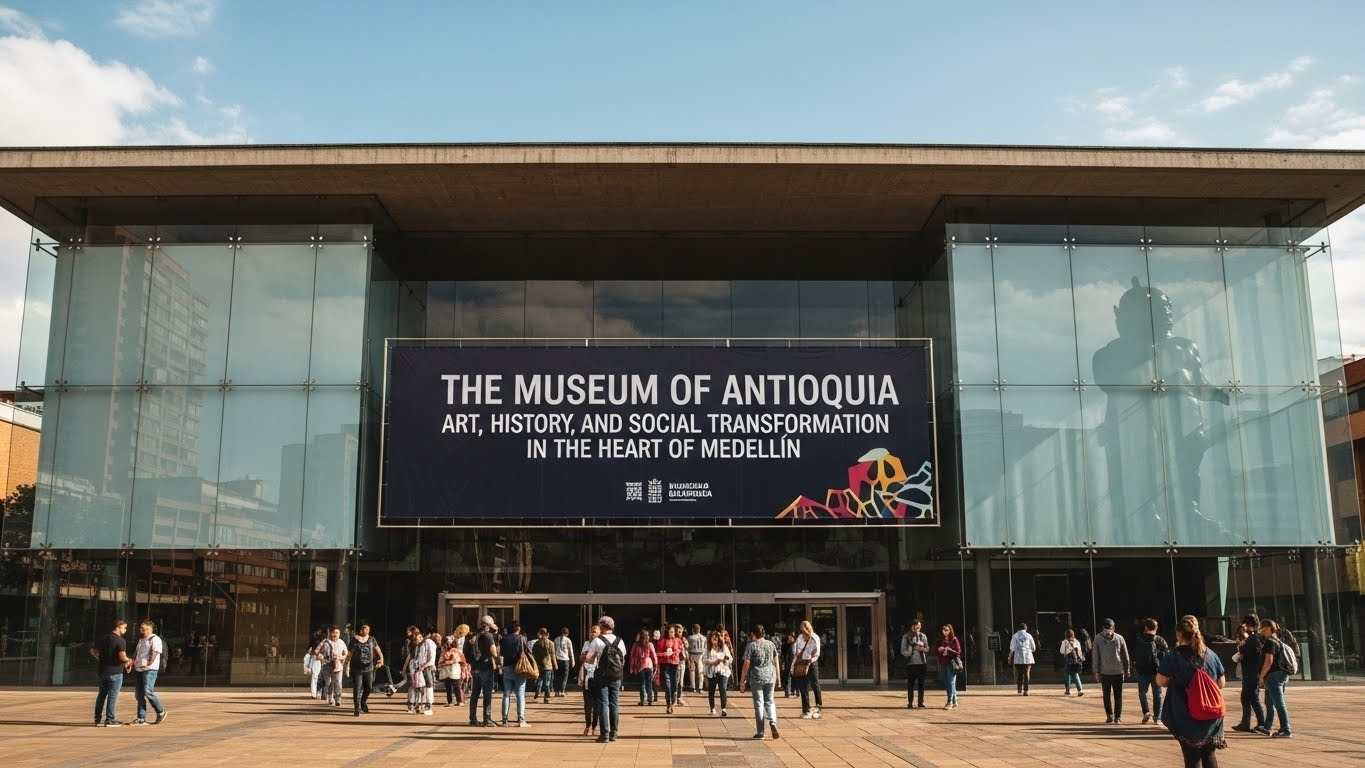

The Museum of Antioquia (Museo de Antioquia) is one of the most important cultural institutions in Colombia and a cornerstone of Medellín’s artistic identity. Located in the historic center of the city, directly facing the iconic Botero Plaza and near the Berrío Park metro station, the museum stands as a symbol of Antioquia’s rich artistic, historical, and social heritage.
More than just an art museum, the Museum of Antioquia tells the story of a region and a city that has undergone profound transformation. Through its collections, exhibitions, and community-driven initiatives, the museum reflects Colombia’s past, confronts its present, and imagines more inclusive futures.
As the first museum established in the Antioquia department and the second museum in Colombia, the Museum of Antioquia holds a unique place in the nation’s cultural history. Today, it is best known for its extensive collection of works by Fernando Botero, Medellín’s most internationally recognized artist, as well as the influential Colombian painter Pedro Nel Gómez.
Location and Cultural Significance
The Museum of Antioquia is strategically located in the center of Medellín, an area that has long served as the city’s political, commercial, and cultural core. Its proximity to Botero Plaza—an open-air exhibition of monumental sculptures donated by Fernando Botero—creates a powerful dialogue between public space and institutional art.
This location is deeply symbolic. The museum does not isolate art behind walls but instead places it at the center of everyday urban life. Visitors, commuters, street vendors, artists, and tourists all intersect in this space, reinforcing the museum’s role as a place of encounter and reflection.
Early Origins: The Zea Museum (1881)
The history of the Museum of Antioquia dates back to 1881, when a group of intellectuals and public figures—including Manuel Uribe Ángel, Antonio José Restrepo, and Martín Gómez—founded the Zea Museum.
The museum was created in honor of Francisco Antonio Zea, a prominent Colombian scientist, statesman, and intellectual figure of the independence era. The original museum was housed in the Library of the Sovereign State of Antioquia, reflecting the close relationship between knowledge, culture, and governance at the time.
The First Collection
The initial collection was diverse and multidisciplinary, reflecting the founders’ broad intellectual interests. It included:
- Books and manuscripts
- Historical documents
- Artistic artifacts
- Weapons, flags, and objects from Colombia’s independence period
- Items from the Thousand Days’ War
- Pre-Columbian artifacts
- Rocks, minerals, and coins
This wide-ranging collection positioned the museum as both a historical archive and a cultural repository.
The Role of Manuel Uribe Ángel
Manuel Uribe Ángel played a crucial role in shaping the museum’s early identity. He donated his personal collection on the condition that he would become the museum’s first director. Under his leadership, the museum developed a strong educational focus.
The museum’s library was especially significant. It contained thousands of volumes related to:
- History
- Art
- Science
It also housed a compilation of the first newspapers published in Colombia, making it an invaluable research center.

Political Change and Institutional Challenges
In 1886, Colombia underwent constitutional reform. Antioquia lost its status as a sovereign state and became a department under central government control. This political shift had major consequences for cultural institutions.
As a result:
- The museum lost autonomy
- It became dependent on the central government and departmental administration
- Funding and institutional stability were affected
These changes marked the beginning of a difficult period for the museum.
Closure and Dispersal of the Collection
Eventually, the museum closed to make way for a new use of the building: it became the palace of Rafael Uribe Uribe, the governor of Antioquia.
During this closure:
- Part of the museum’s collection was placed in storage
- Other pieces were transferred to the University of Antioquia
- Additional items went to the Historical Academy of Antioquia
For years, Medellín lacked a central institution that represented its artistic and historical heritage in a unified way.
Rebirth Through Civic Initiative (1946)
In 1946, two influential civic leaders—Teresa Santamaría de González and Joaquín Jaramillo Sierra, members of the Honor Society for the Betterment of Medellín—recognized a critical cultural gap. Medellín, a growing and dynamic city, lacked a representative museum.
They believed that a museum should be:
- Protected from political interference
- Stable and independent
- Dedicated to public cultural development
To achieve this, they proposed reopening the museum as a private, non-profit entity, ensuring its long-term survival.
Legal Recognition and New Home (1953–1955)
In 1953, the museum received official legal status as a private institution. Two years later, in 1955, it reopened its doors in a new location: the Casa de la Moneda (Coin House).
This building had previously been an aguardiente factory, highlighting Medellín’s industrial past. The site was provided by the National Bank, while the city of Medellín granted the building for the museum’s exclusive use.
This marked a turning point. The museum once again became a visible and active cultural institution.
Name Changes and Identity Confusion
In 1977, the museum changed its name to the Francisco Antonio Zea Museum of Art of Medellín. The goal was to clarify its artistic focus.
However, the name created unexpected confusion:
- Tourists were unfamiliar with Zea’s historical importance
- Locals confused the museum with a wax museum (“Museo de Cera”)
This confusion highlighted the need for a clearer, more inclusive identity.

Fernando Botero and a Defining Moment (1978)
A decisive moment came in 1978, when Fernando Botero made his first donation of artworks to the museum.
Botero, born in Medellín, was already an internationally celebrated artist known for his distinctive style featuring exaggerated, voluminous forms. His donation elevated the museum’s status instantly.
Following this donation:
- A proposal was made to rename the institution
- The name Museum of Antioquia was chosen
- The change was approved by the Governor of Antioquia
This new name connected the museum more directly to the region and its people.
The Museum and Botero Plaza
In 1997, a major renovation process began. At the time, the museum faced:
- Severe financial difficulties
- Low visitor numbers
- Limited public engagement
The renovation was part of a broader urban renewal effort in downtown Medellín. The creation of Botero Plaza, featuring 23 large bronze sculptures donated by Botero, transformed the area into a cultural landmark.
The plaza redefined how art interacted with public space and revitalized the museum’s surroundings.
Museo 360: A New Vision (Since 2016)
A major transformation occurred in 2016 with the appointment of María del Rosario Escobar as museum director. Under her leadership, the museum launched the ambitious project Museo 360.
Philosophy of Museo 360
Museo 360 seeks to redefine what a museum can be. Instead of hiding uncomfortable realities, the museum aims to:
- Recognize the city’s social realities
- Address historical exclusion and discrimination
- Encourage dialogue and critical reflection
According to Escobar, the museum’s mission is to:
“Review history and its stories, and create new stories that are inclusive.”
Inclusive Curatorship and Critical Reflection
The curatorial strategy of the Museum of Antioquia now encourages visitors to question:
- How art history has been written
- Whose stories have been included or excluded
- How museums reinforce social structures
Permanent galleries are designed to provoke reflection on power, identity, and memory.
Nadia Granados and Community Collaboration
One of the most significant examples of the museum’s new approach was the artistic residency of Nadia Granados in 2017.
Working with:
- Curator Carolina Chacón
- A group of sex workers based in downtown Medellín
They developed the award-winning performance “Nadie sabe quién soy yo” (No one knows who I am).
This cabaret-style performance challenged stereotypes and gave voice to marginalized individuals through art.
Las Guerreras del Centro
Following the success of the project, the performers founded Las Guerreras del Centro (Downtown Warriors)—a collective dedicated to highlighting the lives of sex workers through:
- Artistic performances
- Knitting circles
- Community actions
The Museum of Antioquia continued collaborating with this group, fostering long-term partnerships rather than one-time exhibitions.
Redefining the Museum’s Role in Society
These collaborations represent a shift toward critical museology, a practice that seeks to:
- Destigmatize marginalized communities
- Empower participants
- Create spaces for dialogue beyond museum walls
The museum no longer functions only as a building but as an active social agent within Medellín.
The Museum Today
Today, the Museum of Antioquia is:
- A major tourist attraction
- A center for academic research
- A platform for social dialogue
- A symbol of Medellín’s cultural resilience
Its collections, especially those of Fernando Botero and Pedro Nel Gómez, attract visitors from around the world, while its contemporary programs engage deeply with local communities.

Conclusion
The Museum of Antioquia is far more than an art museum. Its history mirrors the political, cultural, and social evolution of Medellín and Antioquia as a whole.
From its origins as the Zea Museum to its current role as an inclusive, reflective institution, the museum has continually adapted to changing times. Today, through initiatives like Museo 360, it challenges traditional narratives and opens new spaces for understanding, empathy, and transformation.
By embracing both art and social reality, the Museum of Antioquia stands as a powerful example of how cultural institutions can help shape a more inclusive and thoughtful society.

Leave a Reply